The Sword & Board

E-commerce IA & Usability Redesign (Solo Project)

Project

Overview

Sword & Board Toronto is a niche tabletop RPG retailer (Warhammer, D&D, miniatures) with a typical small-shop online presence - functional, but difficult to navigate without prior product knowledge.

This project was completed over three weeks (full-time) as a UX exercise using the existing site as a base. There was no access to business stakeholders, analytics, or technical constraints, so decisions were informed by heuristic review, competitive patterns, and limited user input.

The focus was improving product discovery and browsing efficiency, not building a fully validated e-commerce system.

Constraints

  • No access to business or technical requirements
  • No analytics or real performance data
  • Directional research only (5 interviews + heuristic review)
  • Timeboxed to three weeks

Given this, work prioritized navigation clarity and product evaluation, with less emphasis on backend feasibility.

Key Decisions

Simplified Navigation

Navigation was reduced to a high-level entry point, with filtering and limited sub-navigation handling deeper exploration.

Tradeoff: less granular categorization upfront in exchange for faster browsing.

Proposed Redesigned Site Map


Surfaced Compatibility Earlier

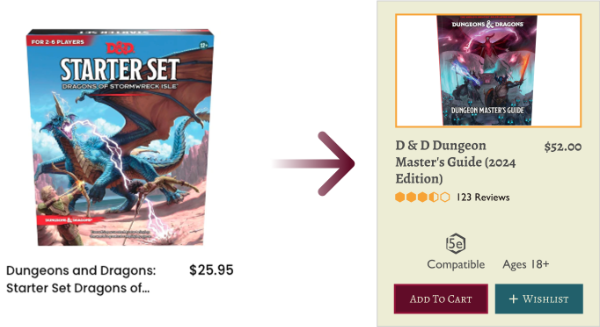
Game system compatibility was moved into product listings, allowing users to quickly assess relevance without opening each item.

Rebalanced Homepage

The homepage was refocused on product discovery (featured items, new arrivals), with events and updates positioned as secondary.

Simplified Checkout

Checkout was consolidated into a single progressive flow to reduce friction.

Note: designed without backend constraints - this would require validation in production.

Established Clear Hierarchy

Layouts were adjusted to follow a consistent top-down, left-to-right structure, improving scanability and prioritization.

What Shipped

What Was Deferred

Note: A Desktop prototype was developed as an MVP. Full prototype can be seen on a larger screen.

Reflection

This project highlighted the balance between usability and thematic design.

The visual direction leaned heavily into tabletop RPG aesthetics. While appropriate for the audience, it risks reducing clarity and would benefit from restraint.

Navigation and filtering improvements were only lightly validated due to time and sample size. With more time, I would prioritize testing these systems at scale and validating their impact on product discovery.

Like to learn more about this project?

Let's Connect!